
Curated by Olga Korper, C.M.
The first time I met Dimitri Papatheodorou was at the Arts & Heritage Centre in Warkworth, where he was serving as chair of the community’s public art gallery. Even then, it was apparent that his ambitions extended beyond exhibiting art.
Together with friends, he was interested in building a place where artists, musicians, writers, and neighbours could gather in meaningful conversation. That vision has since taken physical form in The Periphery, an evolving cultural landscape that contributes to rural Ontario’s distinctive constellation of artistic destinations.
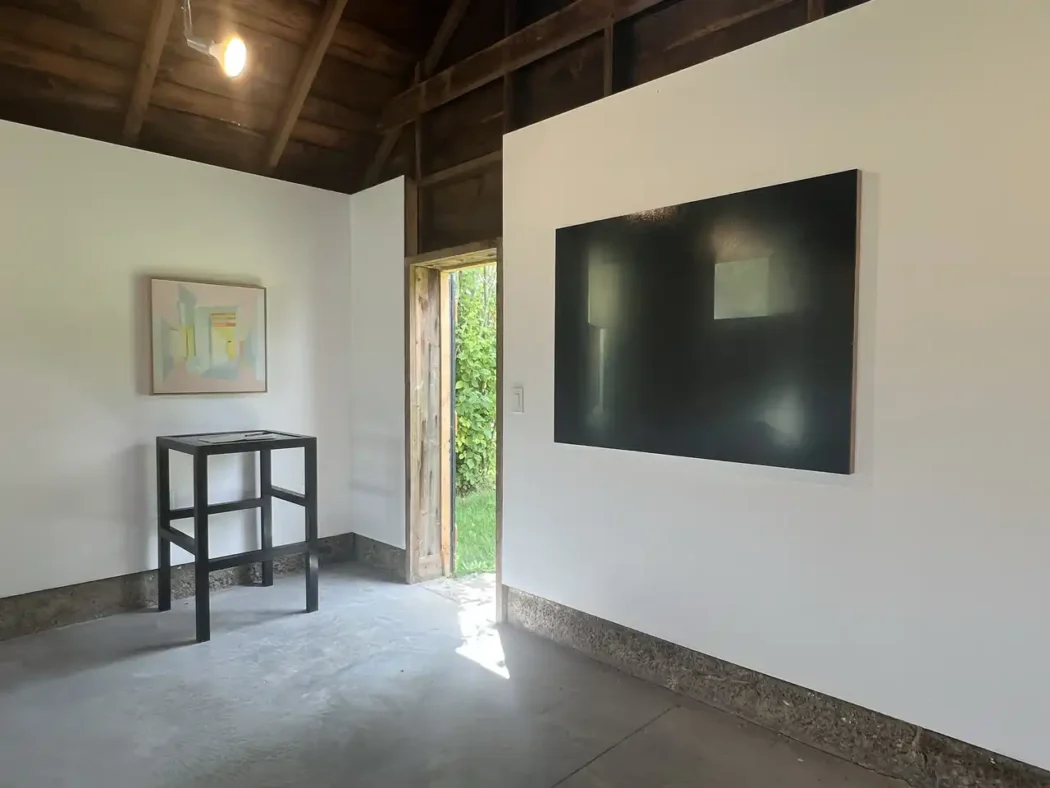
Established in 2021, The Periphery began with the restoration of a 19th-century drive shed into a contemporary private gallery. Its inaugural exhibition featured the work of celebrated Canadian artist Dorothy Caldwell, setting a thoughtful standard for what would follow.

Today, the gallery sits beside Papatheodorou’s newly completed studio, a generous barn-like structure where painting, sculpture, music, architecture, and writing coexist under one roof. Together with the surrounding gardens, outdoor sculptures, and architectural interventions, these buildings create something far greater than a studio. They form a living work of art.
Art writer Gary Michael Dault captured this beautifully when he described The Periphery as “a homestead, an estate, a park, a garden, a multi-faceted, multi-layered installation, a studio, a laboratory, a gallery and a recording studio.”
It is difficult to improve upon that description. Walking the property, one quickly realizes that every path, every building, every carefully positioned sculpture participates in a larger composition. Nothing appears accidental.
For Papatheodorou, however, The Periphery is more than a place. It is an idea.
Dault recounts how the artist has described it as “a place in flux,” “a way of being,” and “a settlers’ landscape, layered with collaborative place-making.” These phrases reveal an artist who understands landscape not as scenery but as something continually shaped through memory, culture, architecture, and human relationships.
Into this landscape comes gallerist and art dealer Olga Korper, C.M., who is both a longtime friend and admirer of Papatheodorou’s work.
Korper’s contribution to visual-art culture in Canada runs deep. Her Toronto gallery, established in the city’s west end, has long been a destination for artists, collectors, writers, and others interested in the possibilities of contemporary painting and sculpture.
For this exhibition, Korper has selected a focused group of Papatheodorou’s paintings concerned principally with light and architectural perception, accompanied by a small number of sculptural works.
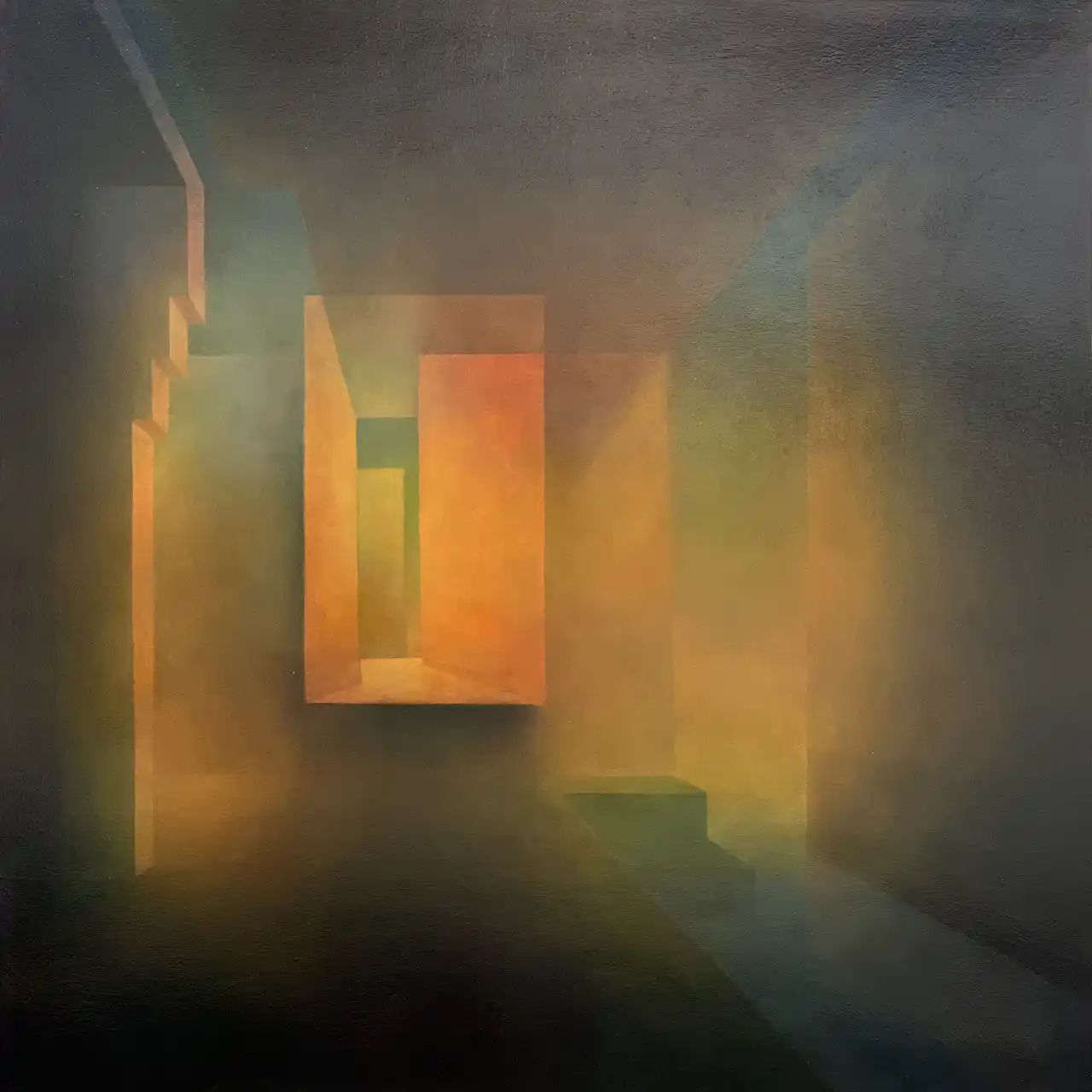
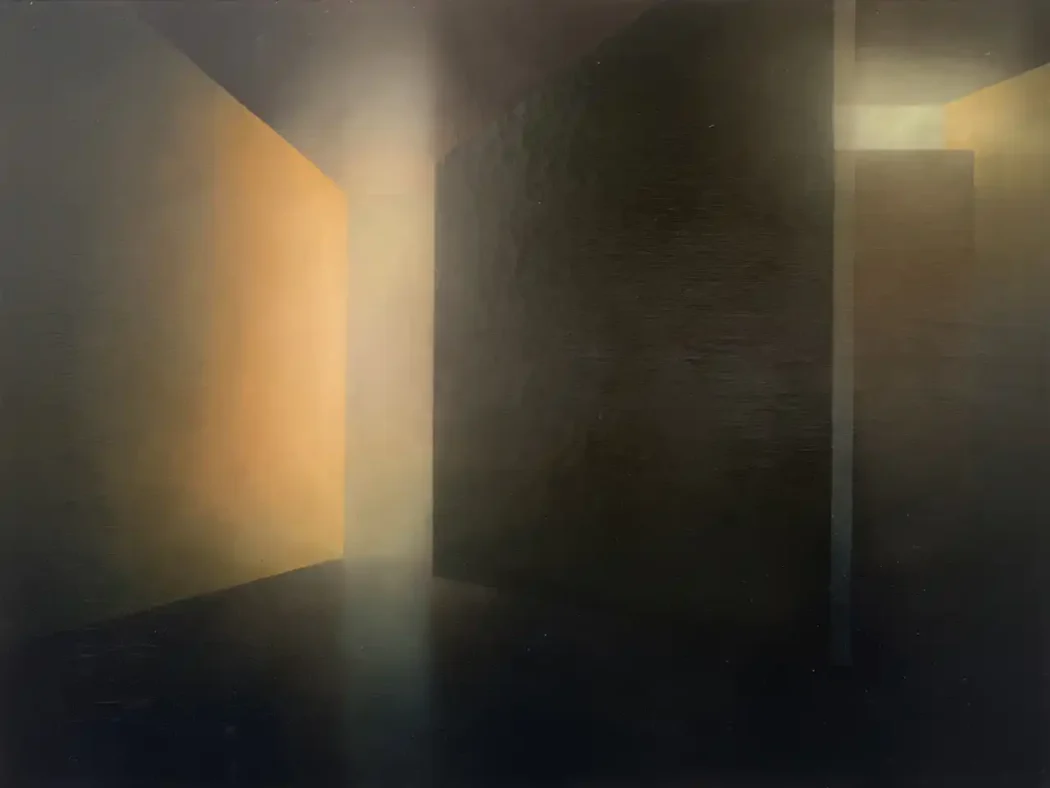
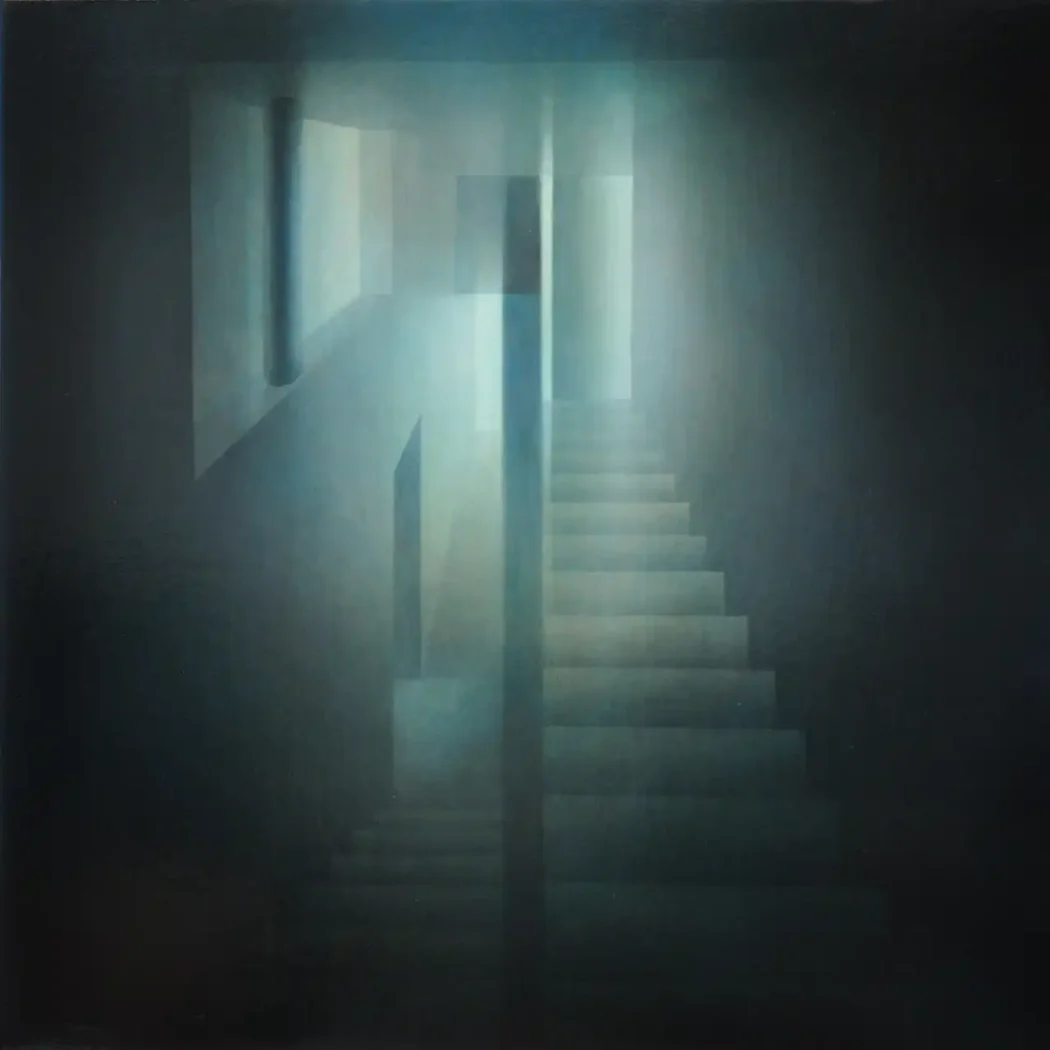
Papatheodorou is perhaps best known for a body of painting that has occupied him for more than two decades: luminous oil paintings that explore the relationship between light, architecture, and perception. Their quiet surfaces seem to radiate from within rather than merely reflect illumination. They belong to an older understanding of light, one rooted in painting, contemplation, and lived experience rather than the instantaneous brightness of digital screens.
Their architectural geometries suggest rooms, corridors, windows, walls, and thresholds without ever becoming literal spaces. They evoke memory more than representation, inviting viewers into moments of reflection rather than narrative. Their philosophical underpinnings are equally rich, drawing upon Plato’s Parable of the Cave, Gaston Bachelard’s The Poetics of Space, and a lifelong fascination with how architecture shapes consciousness.
Gary Michael Dault has written eloquently about these works. He describes them as repositories of “entrapped light” and “reflected light,” ultimately concluding that their mysterious luminosity is “transcendentally provocative.”
When asked about his technique, Papatheodorou characteristically offers a modest answer: the effect is achieved through “layer after layer of meticulous glazing.”
The simplicity of that explanation conceals extraordinary craftsmanship. Each painting is patiently constructed through translucent layers of oil, allowing light to accumulate slowly over time. The process resembles architecture as much as painting: each layer supports the next until an atmosphere, rather than simply an image, begins to emerge.
Yet painting represents only one facet of an unusually interdisciplinary career. Trained as an architect, Papatheodorou studied both drawing and architecture before practicing professionally and teaching architectural design at Toronto Metropolitan University for 20 years. Former students often speak of his generosity as an educator, describing a teacher whose patience and encouragement reflected the same quiet confidence visible in his paintings.
Architecture remains deeply embedded in everything he creates. His paintings are built rather than merely painted; his sculptures possess architectural gravity; even The Periphery itself is conceived as a carefully composed sequence of spaces and experiences. The boundaries between disciplines are porous. A painting can become a kind of room. A sculpture can behave like architecture. A garden can become an installation. A building can become a vessel for memory.
Alongside architecture and visual art runs another important thread: writing. Readers of Grapevine Magazine have become familiar with Papatheodorou through his thoughtful essays on architecture, visual art, music, and contemporary culture.
Whether writing about artists, exhibitions, public space, or rural life, he approaches criticism not as judgement but as an act of close observation. His essays reveal the same philosophical concerns that animate his paintings: ideas of home, memory, place, beauty, and belonging. They remind us that looking carefully is itself a creative act.
His writing also provides another window into the intellectual landscape surrounding the paintings, revealing an artist who is as interested in asking questions as he is in making objects.
Music occupies another equally important place within his practice. As composer and performer, Papatheodorou has released numerous recordings over several decades. Rather than existing separately from his visual work, music forms another language through which recurring questions are asked. Architecture, painting, sculpture, writing, and composition all become different expressions of a single imagination.
Dault addresses this remarkable breadth directly. Rejecting any suggestion that Papatheodorou merely dabbles across disciplines, he argues that every creative practice “beckons him,” observing that painting, sculpture, architecture, music, and writing all emerge from the same disciplined commitment to making.
It is an important distinction. These pursuits are not parallel careers but interconnected parts of one lifelong investigation. Ultimately, that investigation revolves around the idea of home.
Papatheodorou’s work repeatedly returns to the tension between home and exile, between arrival and displacement, between the remembered place and the place one inhabits. These concerns have particular resonance given his family history as the child of Greek immigrants, and they are transformed rather than simply illustrated in his work. The question of where we belong becomes a question of how we construct belonging.
Toward the conclusion of his essay, Dault reflects on conversations with Papatheodorou about Arcadia, the mythical Greek landscape that has become a metaphor for belonging, identity, and spiritual arrival. The Periphery, he suggests, has become inseparable from that search: a place where landscape and imagination meet.
Perhaps this is why the distinction between visiting an exhibition at The Periphery and visiting The Periphery itself begins to dissolve.
Visitors arriving to view the paintings soon discover that the exhibition extends well beyond the gallery walls. The gardens, architecture, sculptures, pathways, and surrounding fields all contribute to an immersive experience in which art and life become increasingly difficult to separate. The paintings illuminate the landscape, and the landscape, in turn, illuminates the paintings.
This relationship between artwork and place is particularly important to understanding Papatheodorou’s current practice. The Periphery is not simply a picturesque setting in which art happens to be displayed. It is part of the work. Its buildings, paths, gardens, fields, and objects have accumulated gradually, each contributing another layer to a larger composition.
In this sense, The Periphery is perhaps Papatheodorou’s most ambitious work. It is also his most open-ended. Unlike a painting, it has no fixed frame. Unlike a sculpture, it cannot be apprehended from a single vantage point. Unlike a building, it is never entirely finished. It changes with the seasons, with exhibitions, with the arrival of visitors, and with the continuing work of its maker and collaborators.
In an age increasingly defined by speed, distraction, and digital saturation, Papatheodorou’s work offers something quietly inviting: an invitation to slow down, to observe carefully, and to inhabit space with renewed attention. And like The Periphery itself, they continue to unfold long after one has left.
To visit The Periphery Gallery and Studio, appointments may be arranged through the website: www.theperiphery.ca.