
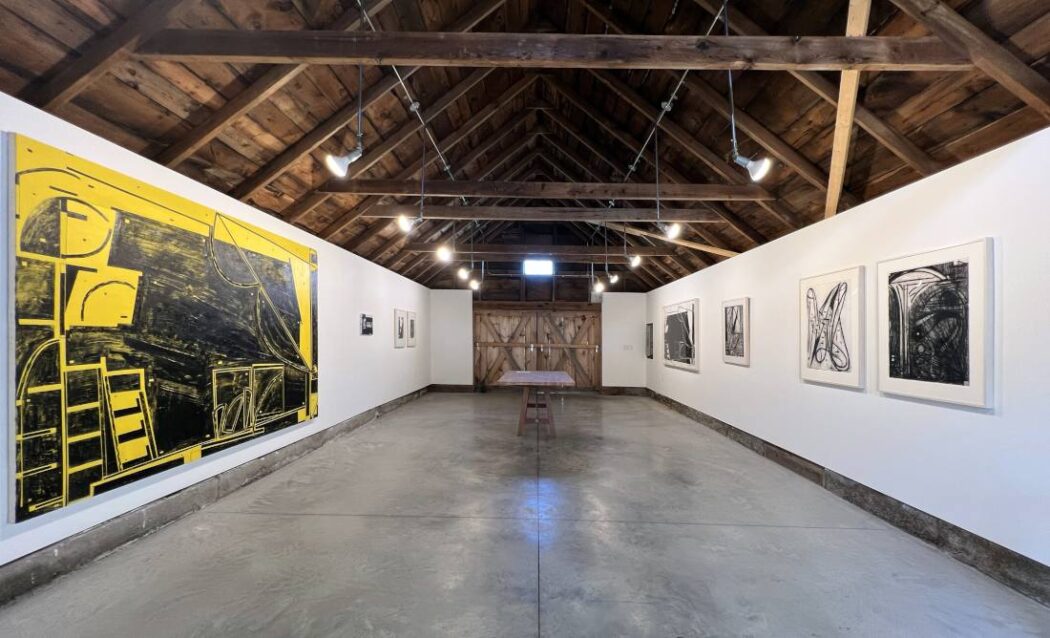
Our arts and architecture columnist, Dimitri Papatheodorou, is hosting an exhibition by Canadian painter Ron Shuebrook at his gallery, The Periphery, near Warkworth, Ontario. In a previous issue, The Periphery was Gary Michael Dault’s subject, described variously as “a homestead, an estate, a park, a garden, a multi-faceted, multi-layered installation, a studio, a laboratory, a gallery and a recording studio,” all organized around an exquisite stone country house dating from 1861. The description is fitting. The Periphery is not simply a gallery in the conventional sense, but where art, architecture, landscape, and lived experience overlap. Situated within the hills and agrarian landscape of Northumberland County, it offers an unusually reflective setting for viewing contemporary art. Shuebrook’s work, with its intensity and structural rigour, enters into dialogue with this rural context, bringing energy to a setting defined by openness, stillness, and cultivated land.
Dimitri and Ron first met last year during Shuebrook’s travelling exhibition at the Art Gallery of Northumberland in Cobourg. According to Papatheodorou, the first thing one notices about Ron is his warmth, generosity, and charismatic twinkling eyes. Now in his eighties, Shuebrook has lived a life profoundly committed to art, not only as a painter, but as mentor, educator, academic leader, and cultural advocate. Earlier this spring, Dimitri visited Ron at his Guelph studio alongside his longtime friend and gallerist Olga Korper, with whom he has exhibited since the late 1970s. Their enduring professional relationship speaks to the continuity and loyalty that has characterized their careers. The Olga Korper Gallery has for decades occupied an important place in Canadian contemporary art, supporting artists whose practices are grounded in material inquiry, conceptual rigour, and formal experimentation. Ron has lived in Guelph for the past twelve years, where he serves as Senior Artist-in-Residence at Boarding House Arts. Alongside his studio work, he continues a long-standing commitment to mentoring artists, extending a career shaped by decades of teaching and academic leadership across Canada.
Shuebrook is Professor Emeritus at OCAD University, serving as President from 2000 to 2005 and Vice-President, Academic, from 1998 to 2002. In 2005, he received a Doctor of Fine Art, Honoris Causa, in recognition of his substantial contributions to Canadian art and arts education. Prior to this, he held appointments at the University of Guelph, University of Saskatchewan, Acadia University, York University, and NSCAD University. His career maps an extraordinary level of engagement with Canadian art institutions, but more importantly, reflects a life in which painting and pedagogy have remained inseparable.
On exhibition at The Periphery are monochromatic works on paper and canvas. Charcoal drawings invoke literary references, particularly to the whalers of Moby-Dick by Herman Melville. The recurring image of tethered bodies becomes a vehicle for exploring interdependence, labour, and survival. As one figure harpoons, another remains physically bound to him, both locked in precarious relation to each other and to the overwhelming force of nature. Shuebrook’s marks are bold, compressed, and deeply physical. One senses the pressure of charcoal being driven into paper, building dense accumulations of line and mass. The drawings convey tension not only as subject matter, but as material fact. Lines are stretched, pulled taut, and bundled into forms that feel simultaneously muscular yet unstable. There is an ever-present sense of imminent rupture, as though the drawn surface itself is under strain.

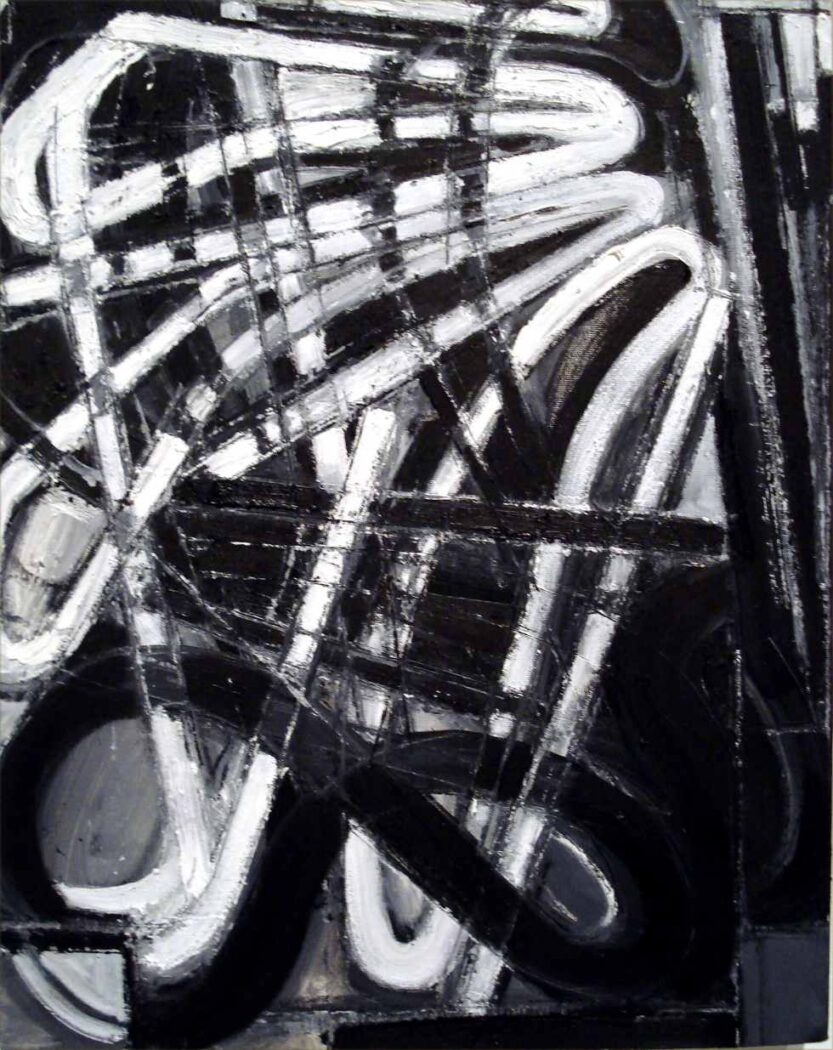
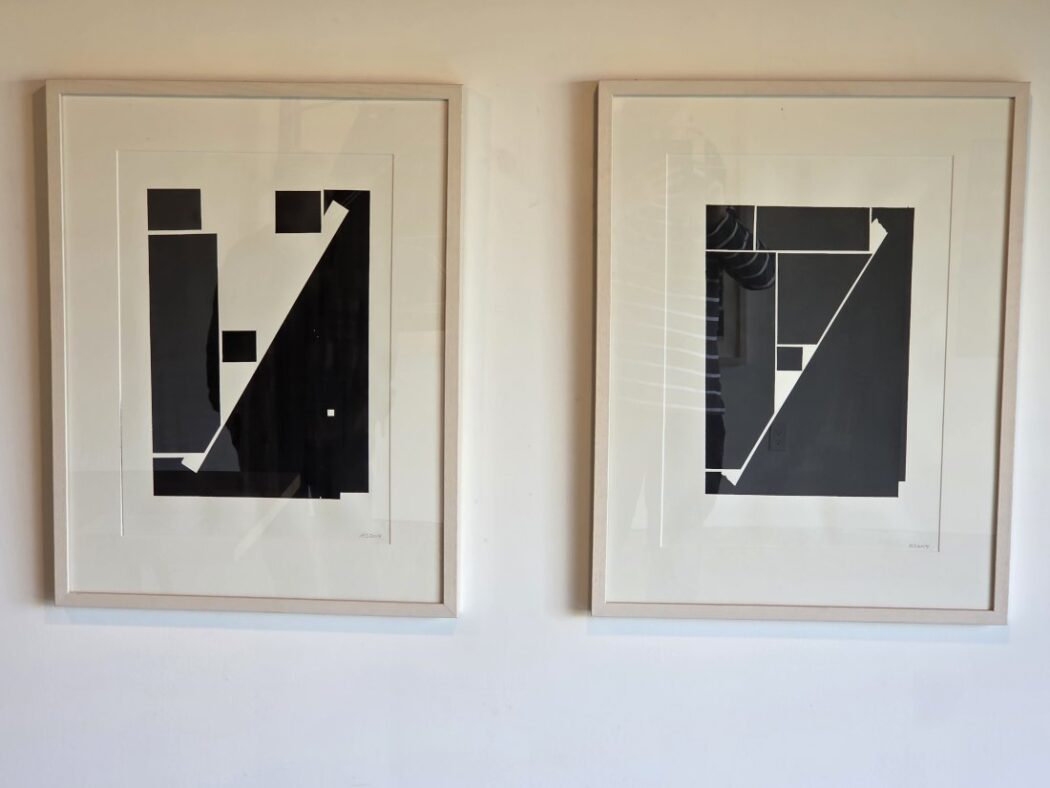
These are not decorative drawings. Their energy is forceful, carrying an expressive intensity that is hard to contain. One can almost feel the instability of bodies balancing on the wet deck of a ship, navigating danger, exhaustion, and uncertainty. The works insist on physicality: labouring bodies, loaded ropes, shifting balance, and the constant negotiation between control and collapse. Two large companion works, one executed in acrylic and the other in charcoal, are particularly compelling. Related in structure and sensibility, each presents a kind of tableau or stage-like arrangement. Their geometric forms recall aspects of Constructivism, while their compositional restraint introduces an almost theatrical sense of anticipation, as if awaiting activation.
There is something both familiar and historical in these works. Circular forms suggest repetition, return, and mechanical rotation, while also evoking the visual language of early twentieth-century theatrical design. In these paintings and drawings, Shuebrook seems to stage an encounter between abstraction and narrative, history and immediacy. The Constructivist reference is especially evocative. One is reminded of that brief utopian moment in Russian art when aesthetic experimentation and social transformation were imagined as mutually reinforcing, before the project was violently upended by authoritarian control. The tight line reappears as metaphor: stretched to its limit, then subjected to forces beyond its own agency. The work is prescient.
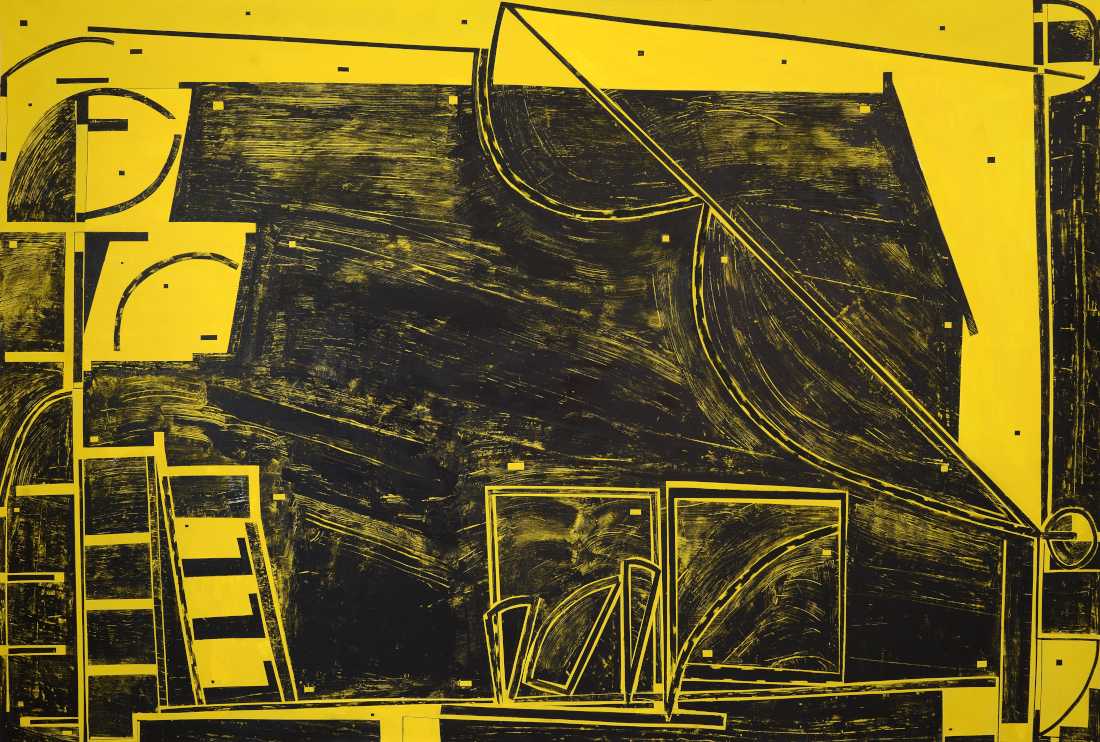
Cumulatively, Shuebrook’s mark-making feels both ancient and immediate. There is something primordial in the drawn gesture, as though these marks emerge from a deep visual memory, yet they remain fully contemporary in their formal intelligence and emotional charge. This installation at The Periphery feels especially distilled and focused. The palette is largely black and white, punctuated by one monumental painting animated by a luminous citrus-yellow field. The introduction of colour is startling, almost theatrical, interrupting the otherwise restrained tonal atmosphere like a flare against overcast weather.
Now in his eighties, Ron Shuebrook has produced work of remarkable vitality and urgency. There is no sense here of softening. The work remains intellectually alert, materially engaged, and emotionally powerful. One leaves the exhibition not with a sense of closure, but with curiosity. What remains is the sense of continuation, that painting, for Ron Shuebrook, is not a completed project but ongoing. One looks forward to seeing what he does next.
Ron Shuebrook at The Periphery runs until the end of July. For more information, please contact theperiphery@icloud.com