
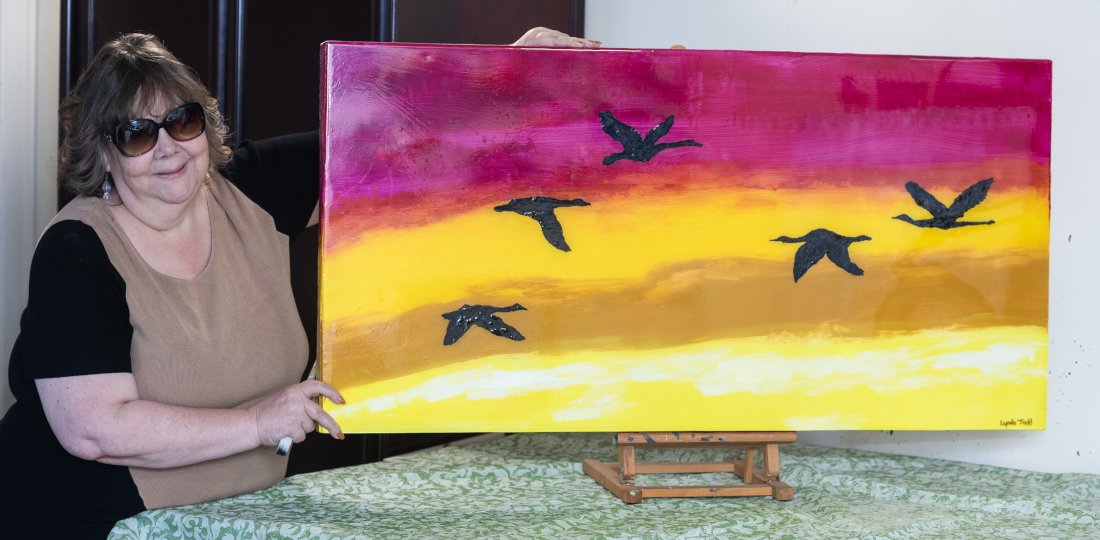
In art galleries, ‘Do Not Touch’ is the rule. Lynda Todd writes a new one: ‘Please Touch.’ That phrase captures the heart of this Peterborough-based visual artist’s work.
Legally blind and colour-blind, Todd doesn’t let limitations define her; instead, she uses them as a catalyst to create tactile, multi-sensory artworks that break down barriers and make art accessible to everyone. She invites people to feel art as much as see it. For her, art isn’t just about looking, it’s about engaging, touching, listening, and connecting across abilities and experiences.
“I look at it as an opportunity,” she says. “Art should be inclusive so everyone can experience it.”
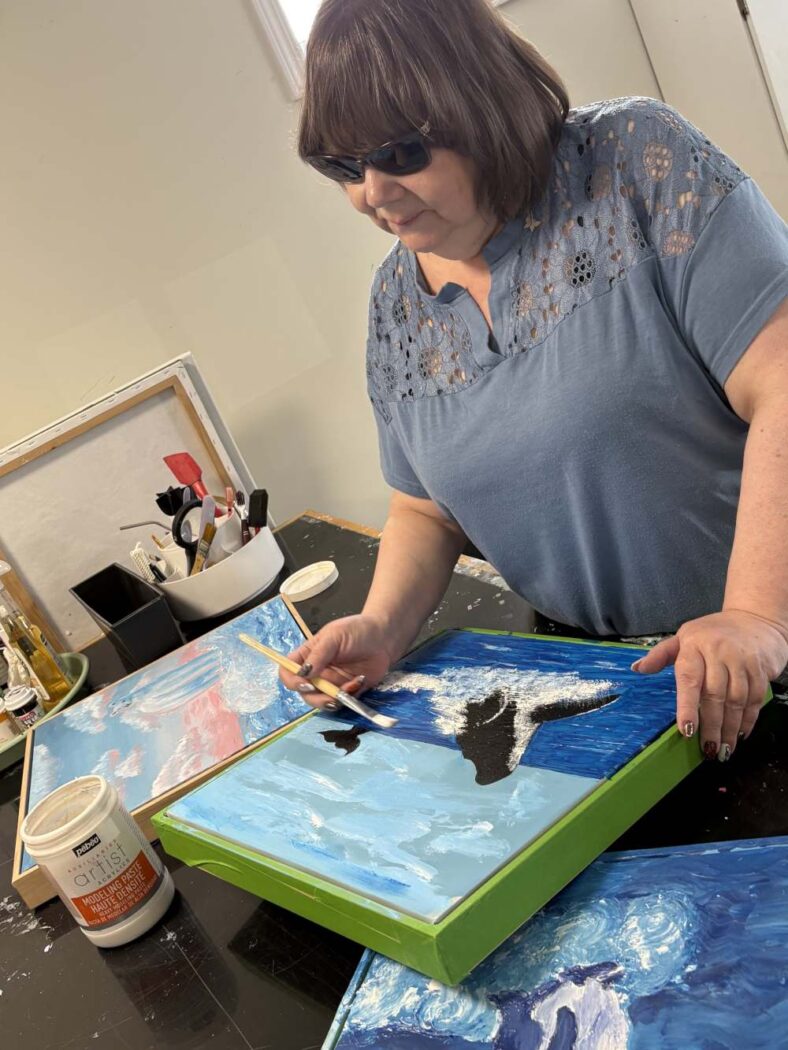
Lynda Todd is an artist, first and foremost. She began her artistic journey as an abstract fluid pour artist, working with liquid acrylics that flow like lava, allowing gravity and movement to shape each composition. From there, she expanded her practice into more tactile acrylic and mixed-media pieces, incorporating layered textures, resin, and dimensional elements creating surfaces that invite touch.

An amazing feat: creating something that encourages onlookers to get involved with her art and touch it, at times hear it, and on occasion, for the visually challenged, have a steward at the ready to explain to the work to patrons.
Her work is rooted in accessibility and inclusion, emphasizing adaptability, movement and survival within the changing fabric of our culture and the personal landscapes that live in all of us.
“My work is inspired by the incredible wildlife and waterways of Canada, from the flight of migratory birds to the quiet resilience of turtles and the journey of salmon,” she says. “It’s important for me to bring attention to those. These creatures and ecosystems are connected through migration and the rhythms of water, yet many are at risk or in decline due to habitat loss, climate change, and other threats. For me, art is a way to celebrate their beauty and raise awareness of their stories. It invites viewers to care as much as I do about the species and places that are part of this land.”
Her innovation has not gone unnoticed. In the last few years, she’s been presented with a Spirit of the Hills Fine Art Award, a Gordon & Arbie Holnbeck Award for Lifetime Achievement, a Canadian Outstanding Emerging Artist Award, and this past year, a People’s Choice Award from the Peterborough Artisans Centre.
She’s also extremely excited as she just learned that her work…a two-foot-square mixed-media piece entitled “Salmon, Salmon, Salmon”…will be displayed throughout 2026 in the In-Camera Dining Room, a private parliamentary dining space located within the Legislative Building at Queen’s Park in Toronto.
Pretty good for a woman who, back in 2019, had never dreamed she would be any kind of real artist, and had no aspirations to become one.
This all brought to my mind field trips to the Ontario Science Centre, where I recalled not being allowed to touch exhibits, but had carte blanche to operate gadgets, press buttons, and even climb on the exhibits. Exploring what was a kind of multi-sensory art, with an audio accompaniment, I enjoyed the hands-on magic of it all. It may not have been exactly art, but that experience made me think of what Todd does.
“I went into it knowing that the pieces could get damaged,” she notes. “I’m fully accepting of the possibility that my creations might get broken. It’s a small price to pay, but it hasn’t happened yet.”
Todd had to teach herself to combine paint with other mediums, including resin and modelling paste. She said she also had to develop new strategies to accommodate her partial colour blindness.
“I label the containers I’m using because even though I may see red in the moment, an hour from now…especially if I’m more tired…I won’t be able to tell that it’s red.”
She explains that even though she is legally blind, that doesn’t mean that she is out of the game entirely when it comes to getting a sense of colour.
“I didn’t plan on becoming an artist; this didn’t really begin until 2019,” she says. “My friend had a gallery; she kept telling me to get in there and show my work. I had no training or anything, I didn’t know any rules, I still don’t, which I think works for me; there are no barriers.”
“She introduced me to another gallery owner, who wanted to showcase my work. I brought my blind friend, who came to show support. I couldn’t describe my art, describe the intricacies of colour to someone who is blind…I dwelled on it, there’s got to be a way, that’s where the inclusivity, the accessibility became central to what I do.” “You have to have a good eye for it.” Yes, I’m aware of the irony, but it’s true.
Todd is best known for her acclaimed series, “Migration: Land, Air & Sea,” which highlights the fragility and majesty of migrating and endangered species such as Salmon, Caribou and the Monarch Butterfly, revealing both their beauty and fragility.
Todd with support from the prodigious Ontario Arts Council and the Province of Ontario, shows a world view that makes her laugh in the face of limitations.
This is how I think of her: she’s a pistol shooter, she practices archery, she’s a tandem bike-riding enthusiast, an axe-thrower mapping out her next endeavour, a renegade who welcomes a challenge.
These are challenging antics even for a fully sighted person! “What’s the worst thing that can happen? If it scares the heck out of me, I’m going to do it!” She’s an adrenaline junkie with a white cane.
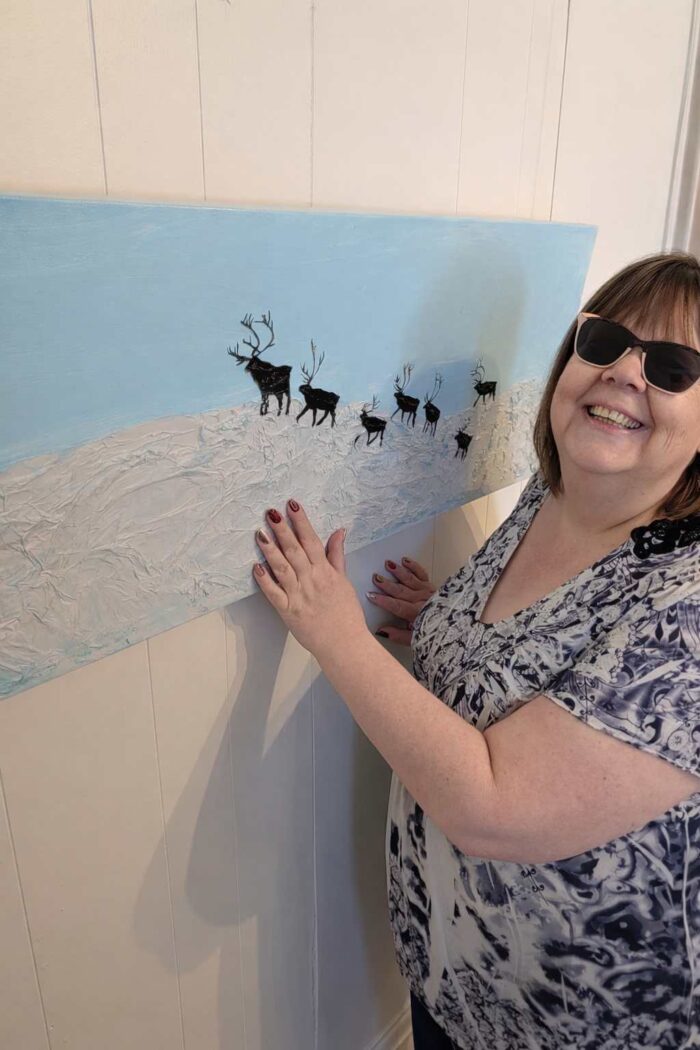
Todd revealed her stunning portfolio to me, and four brilliant pieces that stood out were “Salmon: Sea to Stream,” “Caribou Perilous Trek,” “Monarch Breeze,” and “Sun-kissed” (or The Elephant One, I like to call it).
Each exhibition is designed with accessibility at its core, complete with tactile elements, braille, and audio descriptions, ensuring everyone can fully engage with her art.
“Salmon: Sea to Stream” depicts eight resin salmon in natural tones swimming upstream against an abstract underwater background of swirling blues, whites, and greens. The contrast between the fluid energy of the water and the solid forms of the fish creates a dynamic, visually engaging composition.
“Caribou Perilous Trek” shows six caribou in stark black silhouettes climbing a rugged, snowy slope against a pale blue sky, their minimalist forms contrasting with the textured, tactile terrain. Thick, expressive paint adds depth and dimension, capturing a quiet moment of natural ascent across the landscape.
“Monarch Breeze” centres on a vivid red butterfly set against swirling greens, yellows, and blacks, where contrasting colours and energetic forms create a sense of movement and vitality. The bold interplay between the butterfly and its abstract surroundings makes the composition visually striking and dynamic.
“Sun-kissed” is a 4’ X 4’ gallery canvas featuring a grey elephant with detailed ears, trunk, and tusks, set against a sunset gradient sky from yellow to deep red with a bright, textured white sun. The textured grass below adds depth and enhances the tactile qualities of both the elephant and its natural habitat.
The most recent example of her advocacy is the exhibition “TAP: Touch Art Please,” which was on view at John M. Parrot Gallery in Belleville.. This show invited visitors to physically explore the work.
The paintings incorporated handcrafted and hand-painted butterflies, clouds and other tactile elements that viewers were encouraged to feel. The pieces were hung lower to be accessible to wheelchair users, and audio description was available via a QR code.
Plus, there were ambient or animal sounds that enhanced the experience, all designed to make art engaging for people with visual impairments.
Todd said she wants to design exhibitions that are accessible to people with visual impairments and sensory sensitivities. The title of each work is displayed in large letters and in braille next to each canvas, and on occasion, sighted guides are on hand to describe the colours, shapes and characters of each piece to visitors.
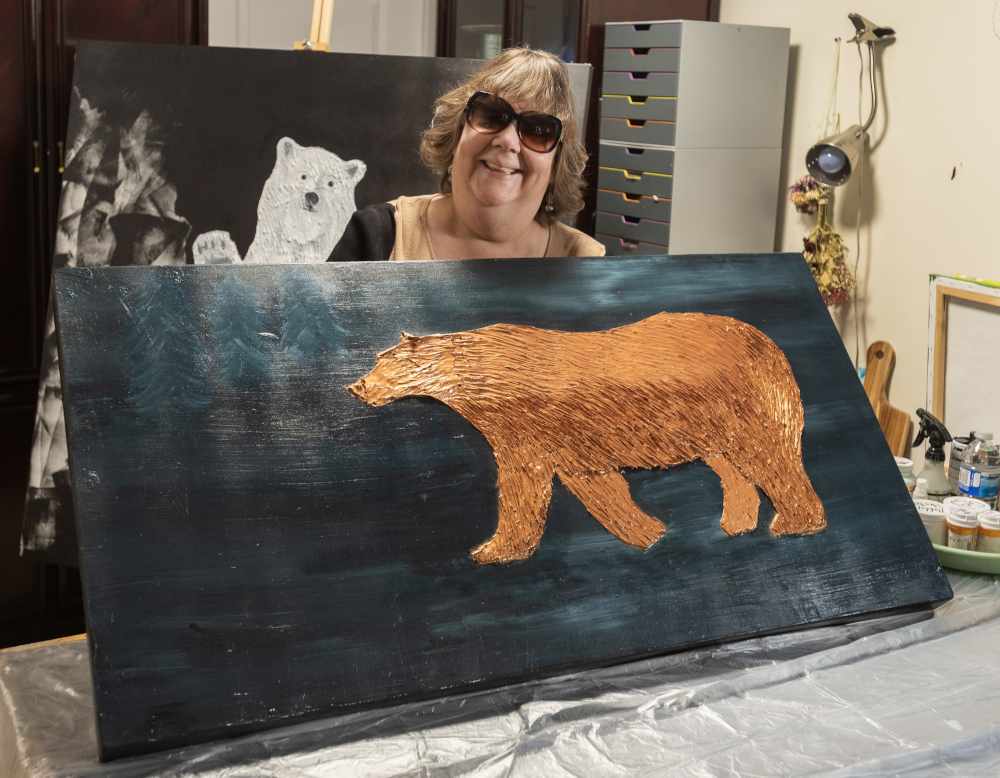
She’s just completed the Migration 3 series and is continuing to develop works depicting polar bears, whales, and penguins.
Nature is often used metaphorically: trees for growth, water for change, mountains for strength. When I bring this up, she comments, “My creations break down barriers and prove that art is not only to be viewed, it is to be felt, shared, and experienced universally.”
Accessibility in Canadian Art Institutions
Todd is not the first artist to create work that goes beyond purely visual satisfaction; she’s in good company. Canadian art galleries and museums are increasingly recognizing the importance of inclusive programming for people with visual impairments.
For example, the AGO’s “Multi-Sensory Tours” incorporate smell, touch, and music to enhance the art experience, providing multiple entry points for appreciation.
Some institutions, such as the Bata Shoe Museum, use hands-on collections and create tactile diagrams of artifacts, and the Kelowna Art Gallery offers tours designed for blind patrons, focusing on verbal descriptions, tactile experiences, and contextual discussions.
Researchers like Patricia Bérubé are developing 3D-printed tactile reproductions of paintings, incorporating different textures to represent colours and lines, allowing visually impaired individuals to “feel” famous artworks.
These efforts reflect an exciting shift in the art world toward inclusive experiences that recognize appreciation as a multi-sensory, cognitive process that extends beyond sight alone.
“In my world, museums will no longer be mere storage houses, but interactive, stimulating exhibits.”
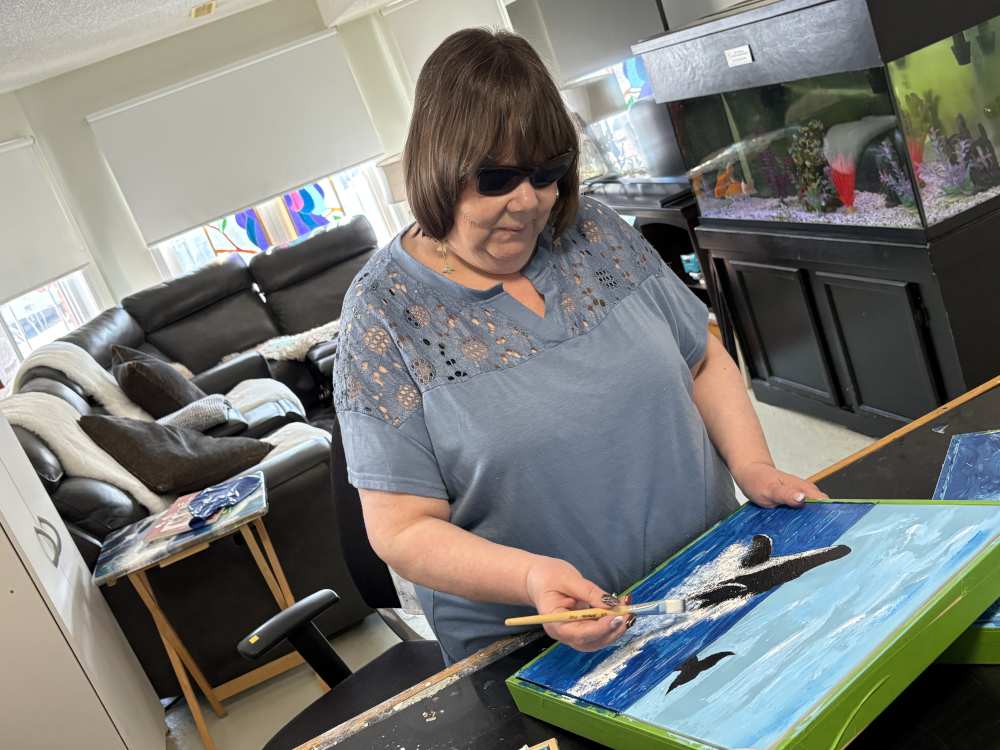
The ability to touch and interact with art, or to engage with detailed verbal descriptions, allows for a deeper understanding and emotional connection, proving that enjoying art is less about seeing and more about thinking.
“I know what it’s like to not be able to see things. They may go by too fast or be too small, or, often in galleries, artwork might be a few feet behind a roped-off area. You’re missing out on so much,” says Todd.
“When I’m working on a project, I’ll blare ’60s and ’70s music, but sometimes, it’s created in silence; whichever way, I always try to stay in the moment. Be present. And then just see where the process takes me.”
“I think it’s different every time, my process. I just go with it; the only decision I make is which animal I’m going to showcase, and whether it’s land, air, or sea. I work on the background first.
“When I exhibited my work at The Quinte Arts Council in Belleville, the curator loved the large-print and braille ID cards and plans on implementing those concepts into exhibits. That is a dream come true. It is one step, and I will work at spreading the concept so that hopefully all galleries and venues will offer 100 per cent accessible exhibits.”
Partnering with organizations like the Canadian National Institute for the Blind (CNIB), Todd’s goal is to bring tactile, multi-sensory art to communities everywhere because for her, art isn’t just to be seen, it’s to be felt, understood, and celebrated by all.
Todd now continues this important work in her Migration Continued series, featuring the Sea Turtle, Whooping Crane, and African Elephant. Through these works, she highlights the urgent need for conservation and the interconnectedness of all life.
Looking ahead, Todd shows no signs of slowing down. She’s currently creating her next textured series featuring the Le Duc Seal, a barn owl, and a Timberwolf, all endangered species that continue her Migration theme of resilience and fragility.
With exhibitions across Ontario…and even in Korea and Japan…each piece is designed from the ground up to be tactile, accessible, and conversation-sparking, inspiring dialogue about accessibility, conservation, and how we experience art as a shared multi-sensory journey rather than just a visual one.
In addition to exhibiting, she gives public talks and workshops to advocate for sensory-inclusive design.
Todd is also open to bringing her accessible exhibitions to other venues across Canada and beyond, inviting galleries, museums, and community spaces to reimagine how art can be experienced by everyone.
The ability to touch and interact with art, or to engage with detailed verbal descriptions, allows for a deeper understanding and emotional connection, proving that enjoying art is less about seeing and more about thinking.