
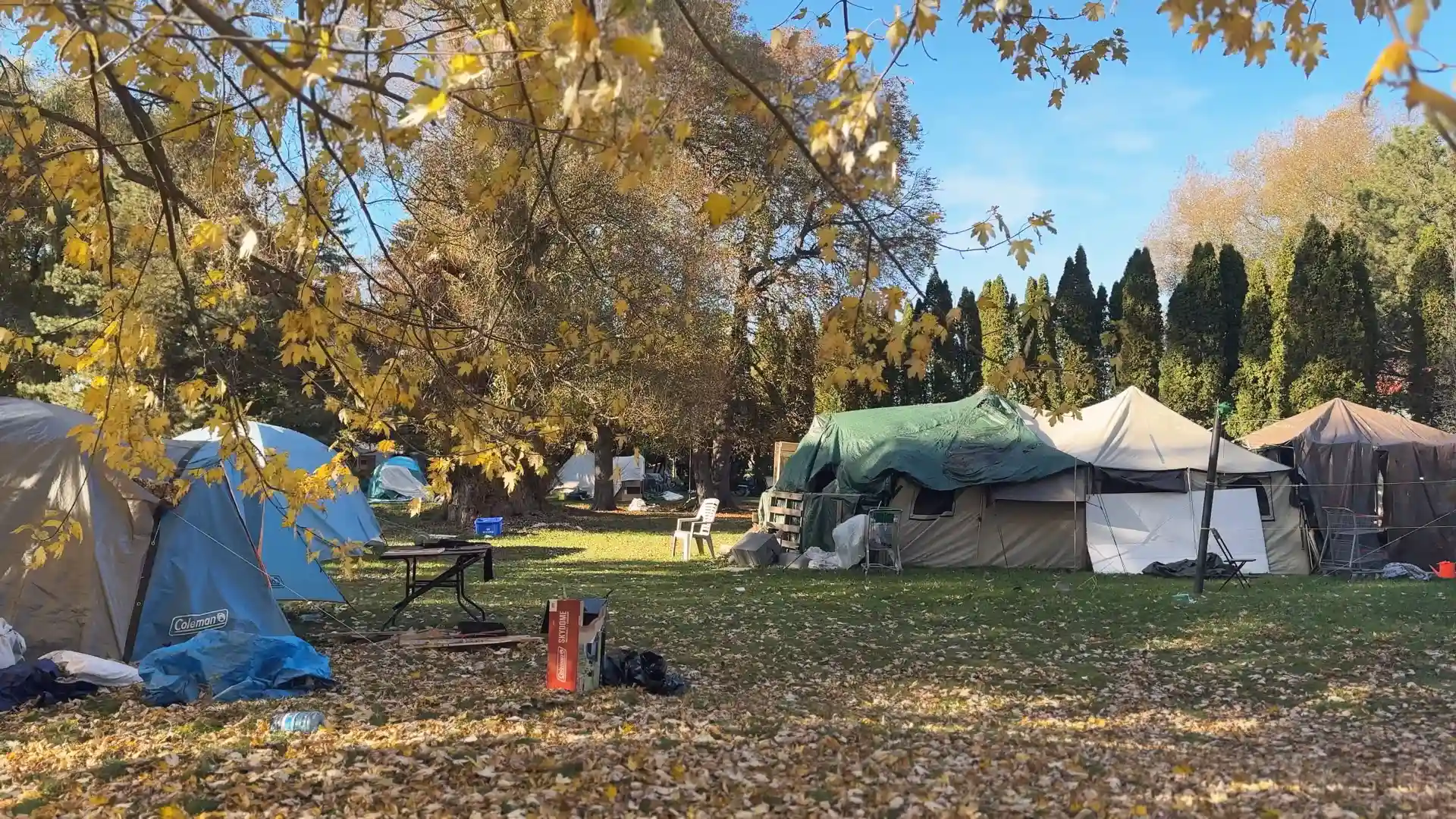
When I drive past a homeless encampment in Toronto, or closer to my home in Cobourg, Ontario, a mixture of feelings surface. As an architect, I can’t help but think about the housing crisis structurally, systemically, politically. I also consider the failed
policies, the economic inequities, the decades of disinvestment in public housing, at all tiers of Government. For most of the people I speak with, those frameworks distill to a much simpler truth: we can do better.
HOME is a new documentary about homelessness. It tells the stories of a few people who have opened their hearts and minds to the camera, allowing us to witness their lives with startling intimacy. The film was produced and created by Linda Schuyler, directed and shot by Will Bowes, edited by Ted Wallace, with research by Kathryn Matheson, music by Jim McGrath, and executive produced by Linda Schuyler and
Stephen Stohn.
Last fall, I attended a private screening of the documentary at the Rainbow Theatre in Cobourg, a retro-cinema tucked into the remnants of a declining shopping mall. The theatre, with its neon lights and worn carpeting, felt like a relic of a more optimistic time. Today, its emptiness feels rather symbolic, the death of a kind of civic space that once brought people together. It felt right, then, that a film about home and
homelessness would find its first public audience there, in this in-between space: a movie theatre as a “social condenser”, a term borrowed from modernist architecture, describing a building intended to foster social interaction and collective empathy.
In line for entry and popcorn, I chatted casually with a man named Jason. Only later did I realize he was one of the film’s central figures. On screen, his story is told with depth and vulnerability that’s rare in documentary storytelling; in person, he was unassuming, quick to smile, generous. That encounter grounded the film for me, homelessness as not a category or statistic, but a person standing beside you, waiting
for popcorn.

What makes HOME so compelling is its narrative form. It doesn’t rely on an external narrator or expert commentary. Instead, it unfolds as a series of vignettes, letting the viewer become their own narrator. Each story builds a quilt of what “home” means
when it’s lost, reclaimed, or reconstructed under dire conditions.
The film’s main participants found temporary refuge on the grounds of the former Brookside Youth Detention Centre, a provincial property later sold to a developer. Their journey, from rented municipal housing, to county land, to Brookside, then to a motel, and finally to nowhere, exposes the instability and fragmentation of our public responsibility.
The camp at Brookside became a microcosm of resilience, cooperation, and daily survival. The residents created their own order, building makeshift dwellings and cared for each other through addiction, mental illness, and loss. For a brief moment, they made a home on land that had once been used to discipline and contain youth. The symbolism was impossible to ignore.
Jordan, who works with the Integrated Homelessness and Addiction Response Centre (IHARC), is one of the most compelling voices in the film. He describes addiction as “a
medical issue that often leads to criminalization.” He reminds us that “if we don’t find a balance between all these issues (addiction, poverty, mental health) anger will build, and we will lose compassion.”
Jason, for his part, says plainly: “Poor people will fall into drugs if they’re poor.” His honesty cuts through the layers of policy and moralism, pointing to the simple correlation between deprivation and despair.

The film also contains the voice of Chief Taynar of Alderville First Nation, who connects the crisis of homelessness to the deeper history of displacement. “Strangers show up at your home, you help them,” he says. “Then they start bringing more friends. They put you in the basement and never acknowledge they’re in your home. That’s the treaty process.” His words make the connection between settler colonialism and contemporary housing insecurity. Both are about the denial of belonging, the erasure of relationship to the land.
Throughout the film, we meet others whose stories echo these same themes. Anne-Marie lives in her car; Amanda, a mother, cannot face her children “like this.” Both
embody the quiet shame that society attaches to homelessness, shame that gets amplified. “When you become destitute,” Jason says, “you become victim to certain
things.” Yet many of the people in the documentary work, volunteer, or support family members while unhoused. Their resilience contradicts the stereotypes often projected
onto them. As the film progresses, its tone darkens. Death and overdose cast long shadows. Yet there are also moments of grace. Pastor Ruth of Calvary Baptist Church offers what
she calls a “Ministry of Presence”, showing up without judgment, offering rides, food, or water, and simply being there. “People are infinitely complicated,” she says, summing up what the film does best: it restores complexity to lives flattened into policy terms.
The film also visits Peterborough, where a Modular Bridge Housing Community project offers a tiny house model for transitional housing. It is modest with heated cabins,
beds, locks, kitchens, and access to healthcare and support staff. “We are writing the book on how to house homeless people as we speak,” an organizer says. The system isn’t perfect, but it works, because it’s based on compassion, practicality, and partnership.
In Cobourg, a similar initiative, a Tiny Homes pilot project, was proposed to Council, creating ten to twelve small transitional units. Initially, it had support. But in the end, Council voted against proceeding, citing concerns about “illegal consumption sites.” I wonder about that, given the fact that “illegal drug use” happens everywhere, including within the privacy of homes, of the well-housed, not just the under-housed or the un-housed.
Meanwhile, the Brookside property, near the centre of Cobourg, was sold by Infrastructure Ontario to a private developer. Once home to a youth detention centre, it is now viewed as a real estate “opportunity.” Executive producer Stephen Stohn puts it
succinctly: “Why a nation such as Canada, which has so much wealth, can’t take care of its weakest citizens is heartbreaking.
Now that Brookside is no longer owned by the people of Ontario, and in the hands of private development, will Cobourg Council ensure balanced zoning parameters for mixed housing, for all income levels, and find an appropriate public use (or uses) for the historic mansion? The transfer of a major public asset – Brookside Lands and Strathmore House – from public to private should come with it a robust set of public design requirements, through a public consultation process and engagement of qualified consultants, implemented locally. This story has yet to be written.
The tragedy of HOME lies not in its subjects’ struggles alone, but in the collective failure it exposes, the erosion of public will, of shared responsibility, of empathy. The people of Brookside weren’t without community. They were without homes.
The film’s closing moments echo in my mind, people displaced once again, forced to find new shelter in the cold, some involuntarily discharged from temporary motel
programs with only days’ notice. It’s a kind of civic trauma, a wound in the social fabric that we (collectively) walk past.
Homelessness can happen to anyone. Lose your job,
your partner, your health, and you may find yourself on the same edge. As one voice in the film says: “It’s not for lack of will. It’s a lack of housing.” I think often about space, who gets to occupy it, who gets excluded, how power is expressed in the built environment. HOME reminds me that housing is not just a design or policy issue. It’s an ethical one. It’s about the kind of society we want to inhabit together.
Can we really not house a hundred people? The question isn’t rhetorical. It’s architectural, political, and deeply moral. It asks not how we got here, but what we’re doing about it now.\
Links:
Bridge Housing, Peterborough: https://www.connectptbo.ca/modular-bridge-housing
IHARC, Cobourg: https://iharc.ca/
Calvary Baptist Church, Cobourg: https://calvarybaptistcobourg.com/about-us/
Dimitri Papatheodorou OAA. MRAIC.
www.theperiphery.